How 5000 consumers across the globe use AI for everyday tasks
January 15, 2026
10 mins
We asked 5000 consumers how they're using AI—and how they feel about it. Read on for the full report and watch the video highlights below.
Introduction
AI has become part of daily life for billions of consumers across the globe.
What are consumers actually using AI for? How do they feel about it? What do they wish that AI could do that it can't currently?
We ran a survey 5000 people to explore these questions, collecting quantitative data as well as detailed videos to hear people's thoughts and feelings about AI.
What we learned
Personal AI use has become habitual
Across all 13 markets we surveyed, most consumers use AI for personal tasks on a daily basis, becoming an integral part of their routine.
Practical, repeatable tasks drive adoption
Consumers rely on AI for informational tasks like learning and health advice, while the most time-consuming tasks like home maintenance lag behind.
Most consumers use multiple AI tools
While ChatGPT dominates usage, many consumers are building personal "AI toolkits" and actively switch between multiple tools based on task and context.
Workplace exposure shapes personal AI use
People in digital industries use AI more at home, while those in hands-on fields show lower adoption both at work and personally.
Accuracy and privacy are top concerns
The vast majority of users cite these as top barriers, with many pointing to AI hallucinations and uneasiness around sensitive topics.
Consumers want more humanlike, personalized AI
Users expect AI to remember context, learn preferences, and feel more natural in conversation.
Methodology
Our study included N=4814 consumers in 13 different markets, ages 18-54. Respondents were recruited via User Interviews and screened for previous AI usage. We used Voicepanel to automatically collect video responses, translate transcripts, perform thematic analysis and generate highlight reels. All respondents consented to their select highlight clips being included in a public report. For further details, see our full methodology.
Personal AI use has become habitual
Consumers aren't just using AI at work—they're using it daily for personal tasks, and this pattern holds universally across all markets we surveyed.
Frequency of AI usage for personal (non-work) tasks
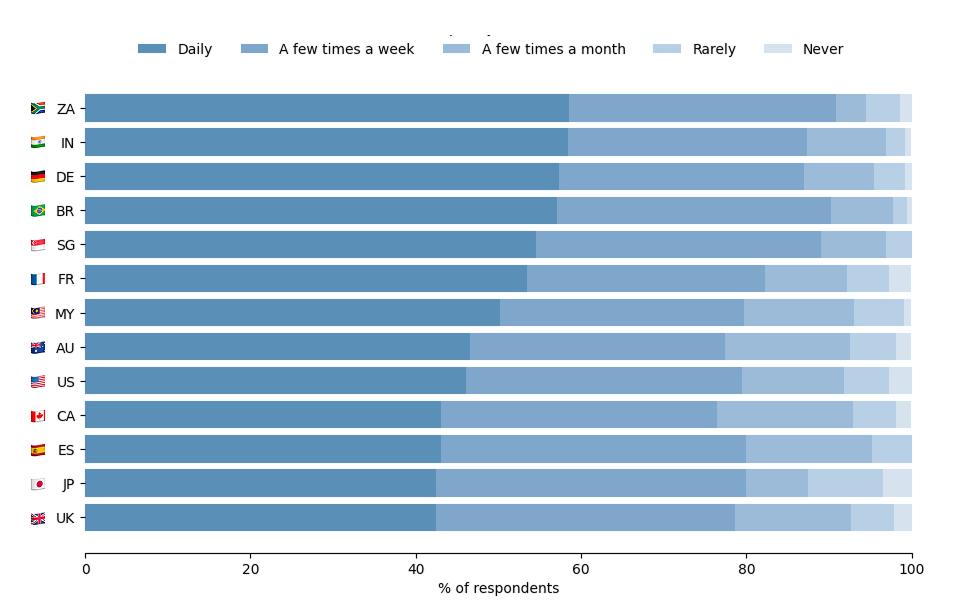
Q: How often do you use AI tools (e.g. ChatGPT, Gemini) for personal (not work related) tasks?N=4814.
The global data reveals exceptionally high levels of regular engagement. Daily use is the dominant behavior across the sample we surveyed.
Growing confidence and efficiency through AI
AI consistently makes people feel faster, more capable, and more confident by offloading cognitive work, accelerating problem-solving, and providing quick access to synthesized knowledge.
Watch the highlights

Practical, repeatable tasks drive adoption
Across markets, AI is becoming a trusted helper for the everyday decisions that shape people's routines.
Primary use cases
AI is gaining traction for informational tasks and learning, where it clearly saves time, builds confidence, and fits naturally into daily decision-making.
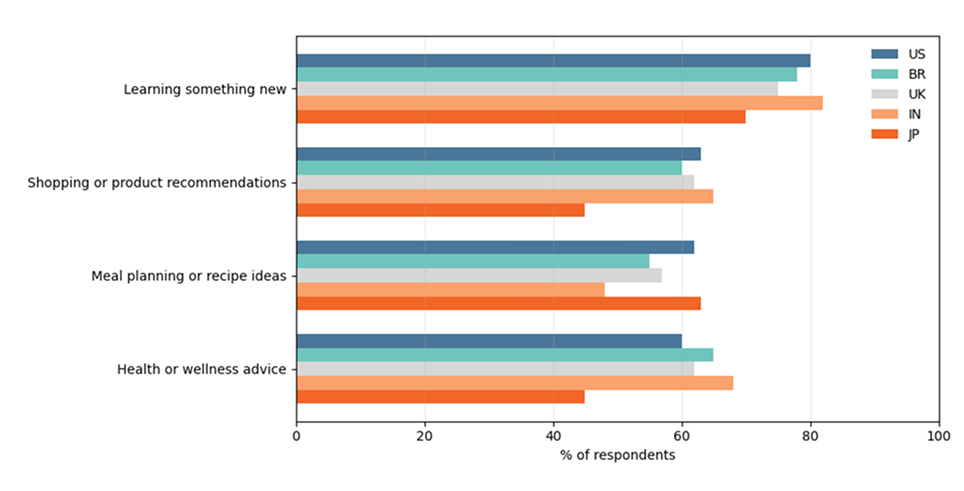
Q: In the past 3 months, which types of personal (not work related) tasks have you used AI tools for?N=2027.
Expanding into creative, practical, and edge use cases
AI is being adopted opportunistically across immigration research, fitness planning, nutrition, travel, coding, and creative work—often replacing multiple tools or even professional services.
Watch the highlights

AI as an accessible and compassionate health guide
People increasingly rely on AI for health-related questions to gain clarity, reassurance, and emotional support—especially when traditional search tools feel overwhelming or insufficient.
Watch the highlights

Secondary use cases
Adoption beyond everyday, low-risk tasks is slower and seems to be influenced more by local attitudes toward trust, risk, and personal decision-making, revealing where cultural context shapes deeper engagement with AI.
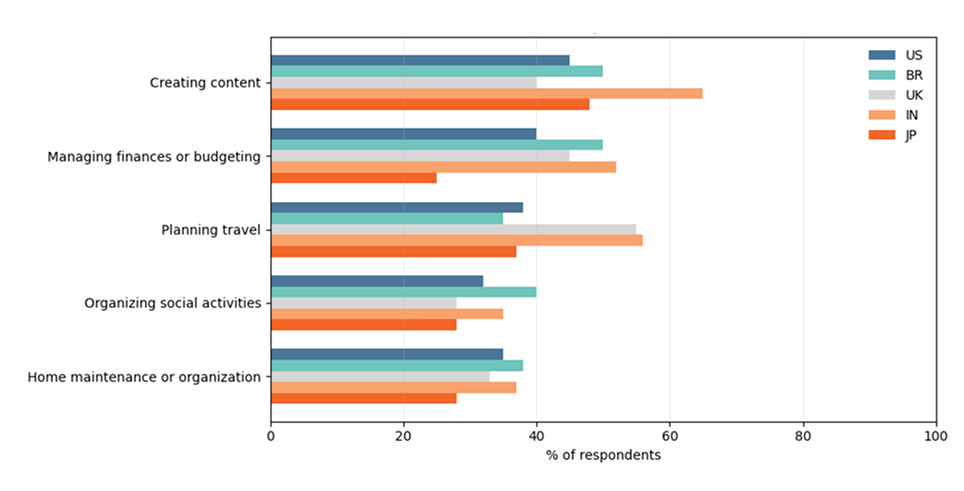
Q: In the past 3 months, which types of personal (not work related) tasks have you used AI tools for?N=2027.
Strong desire to automate everyday life and mental load
Users want AI to handle routine household chores, scheduling, planning, and organization in order to reduce mental overhead and free time for more meaningful activities.
Watch the highlights

Most consumers use multiple AI tools
Across surveyed markets, consumers are assembling small AI toolkits, using different tools for different purposes, underscoring the importance of AI tool ecosystems, interoperability, and differentiation over single-tool dominance.
Tools used
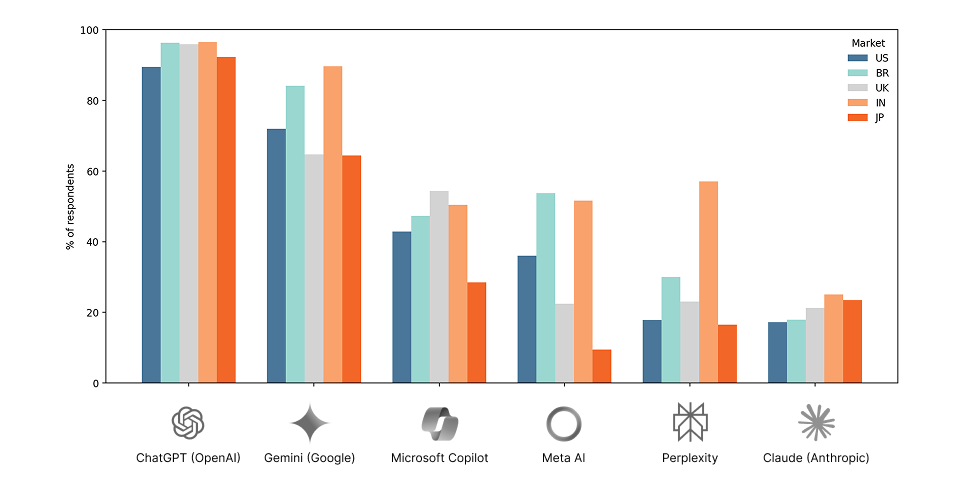
Q: Which of the following products have you used in the past 3 months?N=2027.
Number of AI tools used
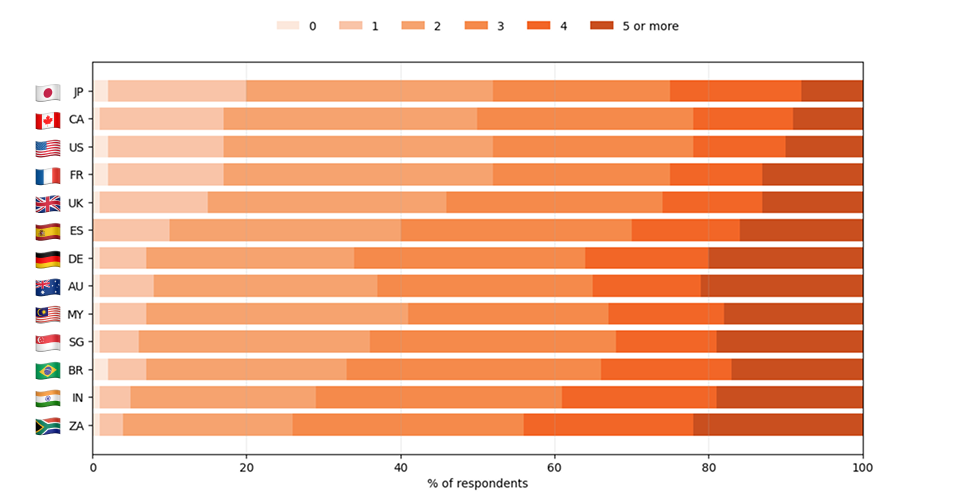
Q: How many different AI tools would you say you've used for personal tasks in the past 3 months?N=4814.
While most users across the markets surveyed use two or three AI tools, the top tools used varies significantly across markets.
A multi-tool AI ecosystem, not a single winner
Rather than committing to one platform, users actively switch between AI tools based on speed, integration, and task fit, creating a fragmented but flexible AI workflow.
Watch the highlights

Workplace exposure shapes personal AI use
Personal AI adoption closely mirrors workplace exposure, with workers in digital, information-driven industries using AI more frequently in their personal lives, while those in hands-on or regulated fields adopt it more slowly, reflecting how comfort with AI at work carries over into everyday use.
AI usage for personal tasks, by employment industry
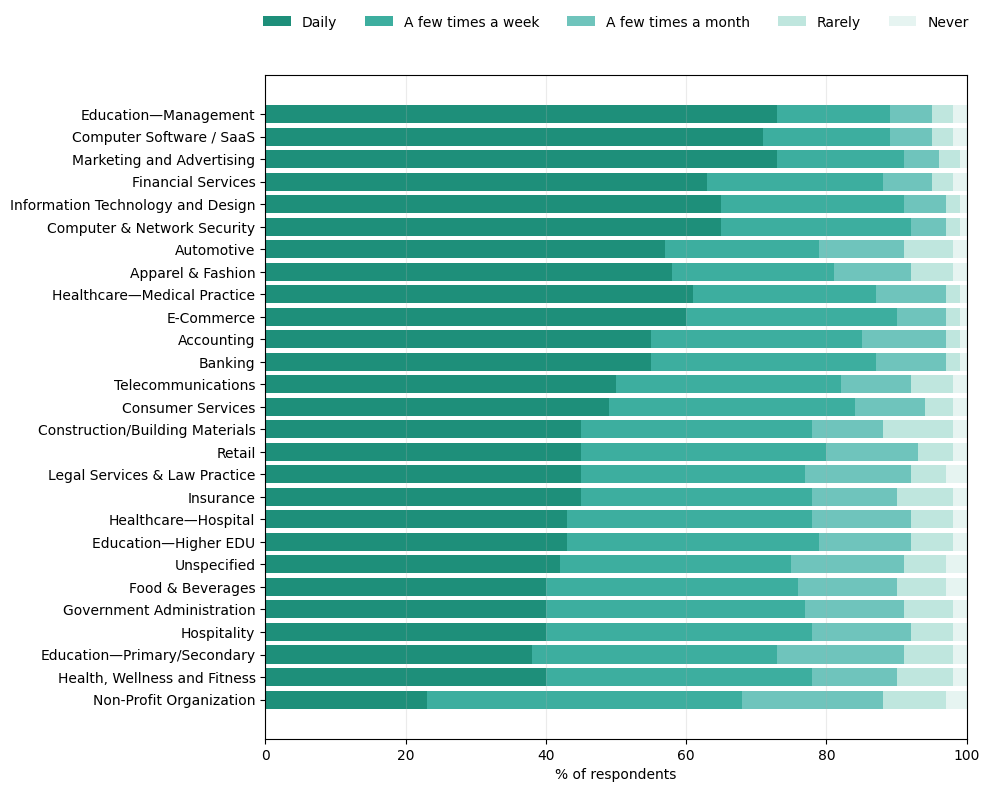
Q: How often do you use AI tools (e.g. ChatGPT, Gemini) for personal (not work related) tasks?N=4814.
Accuracy and privacy are top concerns
Despite broad adoption across markets, consumers consistently cite concerns around accuracy, privacy, and response quality, highlighting that trust and reliability gaps need to be addressed before they expand personal AI use.
Primary barriers
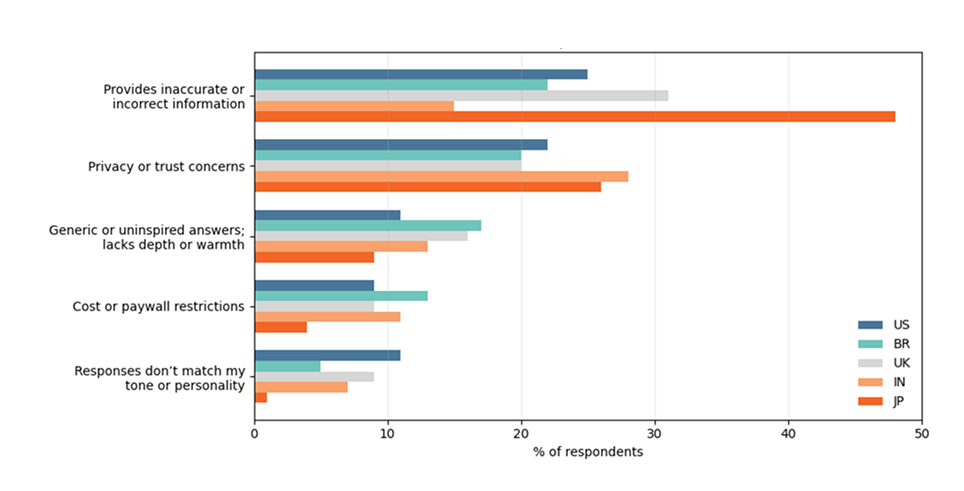
Q: What would you say is the biggest issue or limitation you've run into when using AI for personal tasks?N=2027.
Secondary barriers
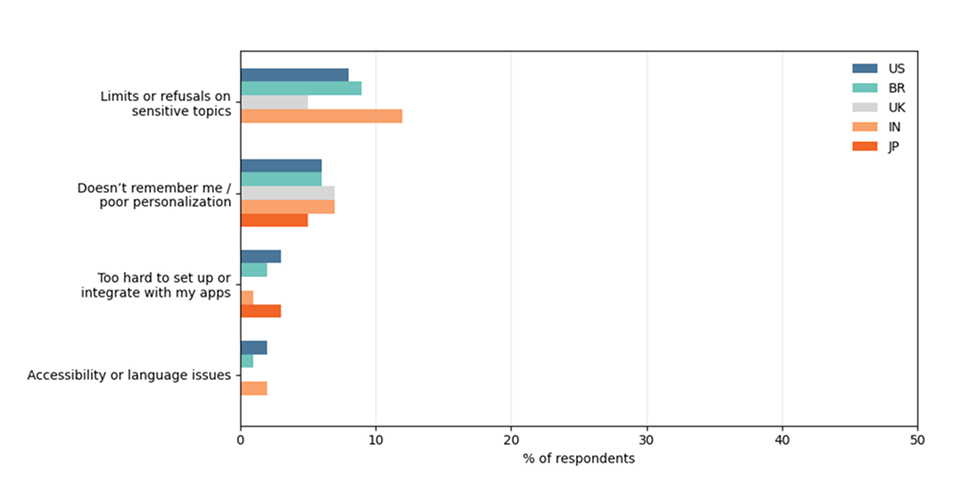
Q: What would you say is the biggest issue or limitation you've run into when using AI for personal tasks?N=2027.
Ongoing anxiety around privacy and data control
People remain uneasy about how their data is stored, reused, or shared, and want stronger guarantees, transparency, and control over conversation history and sensitive information.
Watch the highlights

Persistent concerns about accuracy and hallucinations
While powerful, AI is seen as unreliable at times, with users frequently encountering hallucinations and incorrect answers—driving a desire for clearer signals of confidence and source reliability.
Watch the highlights

Consumers want more humanlike, personalized AI
As consumers become more familiar with AI tools, their expectations are evolving beyond basic functionality. Many users expressed a desire for more personalized and humanlike interactions with AI systems.
Aspirations for AI to become a life optimizer
Users imagine AI evolving into a coach, financial advisor, home manager, and business partner—helping them improve health, finances, learning, and long-term outcomes.
Watch the highlights

Desire for warmer, more human-like interaction
Many users feel current AI interactions are overly robotic and want conversations that feel more natural, emotionally intelligent, and human.
Watch the highlights

Strong demand for deeper personalization and memory
Users expect AI to remember prior context, routines, and preferences, and become frustrated when tools feel stateless, inconsistent, or unable to learn over time.
Watch the highlights

Conclusion
AI is now deeply embedded in daily life across the globe with adoption driven primarily by use cases that deliver practical, everyday value.
While adoption is widespread and growing, trust remains fragile. Users want more accurate, transparent, and personalized systems that can better understand their routines and preferences while respecting their data and privacy. The next wave of AI adoption will depend on how well these tools address core concerns around reliability, privacy, and personalization.
Methodology
For this study, we collected responses from N=4814 consumers across 13 different markets - United States, Canada, United Kingdom, Germany, France, Spain, South Africa, Brazil, Australia, India, Japan, Singapore, and Malaysia. We restricted the sample to ages 18-54 and to people who have used AI at least once in the past. All of the charts in this report has been re-adjusted to match country 2025 census demographics based on age and gender. The sample was collected between October 25 and November 12, 2025.
Questions were automatically translated into respondents' preferred languages (English, French, German, Spanish, Brazilian Portuguese, Hindi, Japanese, Bahasa Melayu) using LLMs. All responses were translated back into English for reporting purposes.
For respondents that agreed to be interviewed, we collected video responses to answer additional questions on their feelings about AI. Respondents all agreed to be included in a public report and their personal details have been removed for privacy.
To provide global breadth while keeping comparisons clear, we've restricted some of our charts to just 5 markets: United States, United Kingdom, Brazil, India, and Japan to represent a mix of mature and emerging digital economies, different levels of English-language alignment, distinct cultural attitudes toward technology, and varying AI adoption curves. This combination allows us to illustrate meaningful global contrasts without overwhelming the reader with data from 13 separate markets.
We used User Interviews for recruitment & screening of the sample and Voicepanel response collection, automatic translation, thematic analysis, and highlight reel generation.
Thank you
Thank you to everyone involved in making this report possible, particularly User Interviews for their partnership in recruitment and screening, Allie Rubenstein who drafted the report, and to the respondents who took the time to share their thoughts with us.