Segmentation that's better, faster, cheaper: yes, you can have all three

David Yin · Fractional Head of Research
November 11, 2026 · 4 mins
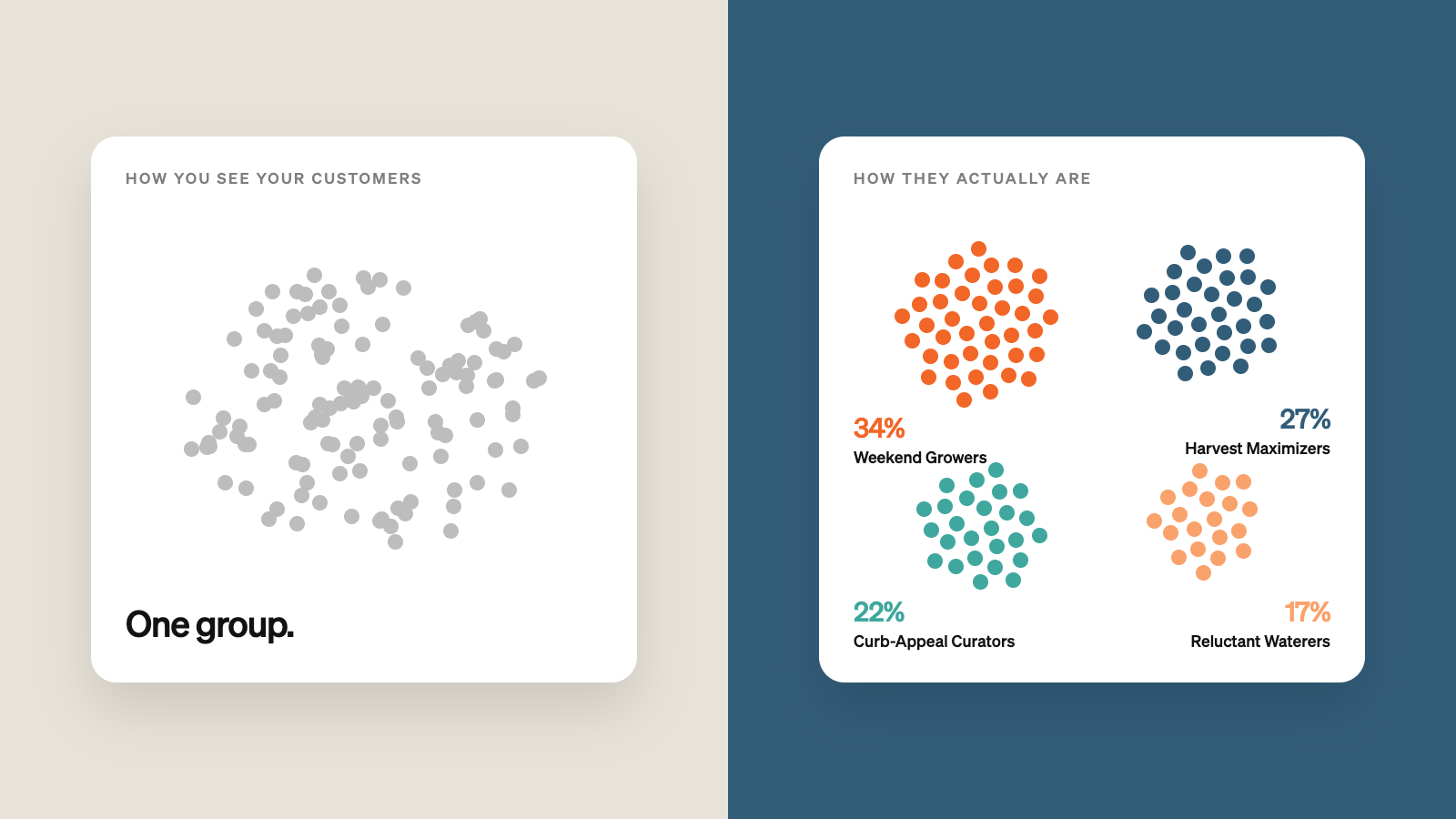
So many companies don't understand their customers. Part of the problem is that they think of their customers as one group. They're not. Most customer bases are made up of diverse subgroups with different needs and motivations.
The typical way to understand those subgroups has been a segmentation. But traditional segmentations have been out of reach for most companies. They're expensive. They're hard to set up and interpret without expertise. They take too long for how fast business moves now. And on their own, they often don't surface enough of the "why," which leads to more research that's also expensive and time-consuming. Then if something in the market changes, there's always a question about whether the segmentation is still relevant.
Starting with the customer's language
When AI burst onto the scene, one of the things that made me most excited was the potential to get even closer to what customers think and feel.
Traditional segmentation surveys use the language of the team, the company, or the researchers, not necessarily the customer's language. That gap can create all kinds of bias and misinterpretation issues.
When I started working with the Voicepanel team several years ago, segmentation was one of the areas where I was most excited about their AI moderation technology. If we could collect customers' motivations and needs in their own words, then create groups based on that language, we could reflect the market better than ever by being closer to customers than ever. I was grateful the Voicepanel team was excited and game to experiment with me.
Years later, we've worked on segmentations together for many clients using this approach, and the methodology keeps getting better.
Pop-Up Segmentations
I call them Pop-Up Segmentations because they can be done in weeks instead of months, for a fraction of the cost of a traditional segmentation.
They also give teams a deeper, more nuanced understanding of their customers. Better, faster, and cheaper.
Here's how the approach works:
- Structured survey questions combined with a large number of open ends, probed with AI to get past the first surface response.
- Flexible response formats. Depending on the study, people can answer by typing or by recording audio or video, and recorded responses are transcribed at scale.
- Stronger fraud detection. Recorded responses make fraud easier to spot, and video adds another layer. For example, you can see whether someone is who they claim to be demographically.
- LLM-driven clustering that builds robust segments from both structured and unstructured data.
Quant and qual in one study
Normally a quantitative segmentation is followed by qualitative research to bring the segments to life. This approach does both at once.
The AI-probed open ends capture what each segment thinks and feels in their own words. When responses are recorded, we can also build audio and video reels for each segment. That saves even more time.
Customers' own words, and especially their voices, help cross-functional teams connect not only rationally to the data, but emotionally to the people behind it.
What we've seen
We've used this approach with B2C and B2B customers, in categories from gardening to medical devices.
In one study, we combined a client's own customers, recruited from their database, with externally recruited consumers. The side-by-side comparison showed the client was over-indexing in one segment and under-indexing in others. That pointed to a clear opportunity to grow by changing who they marketed to.
For another client, we ran the segmentation with their users and connected each person's responses to their behavioral data. In past roles, I've seen the link between behavior and attitudes be very weak. Here we saw strong relationships between the two, likely because the customers' own language drove how the segments were created.
Why this matters now
When the market is changing this quickly, teams can't wait three to six months for a segmentation. And the cost of a traditional segmentation plus follow-on qualitative research puts it out of reach for most smaller companies.
Pop-Up Segmentations make segmentation fast enough to keep up with the market and accessible to far more teams.
Learn more
If you want to understand the subgroups in your customer base, talk to the Voicepanel team to learn more about Pop-Up Segmentations.