AI customer research, explained for research teams

John Provine · Co-Founder & CEO
November 10, 2026 · 9 mins
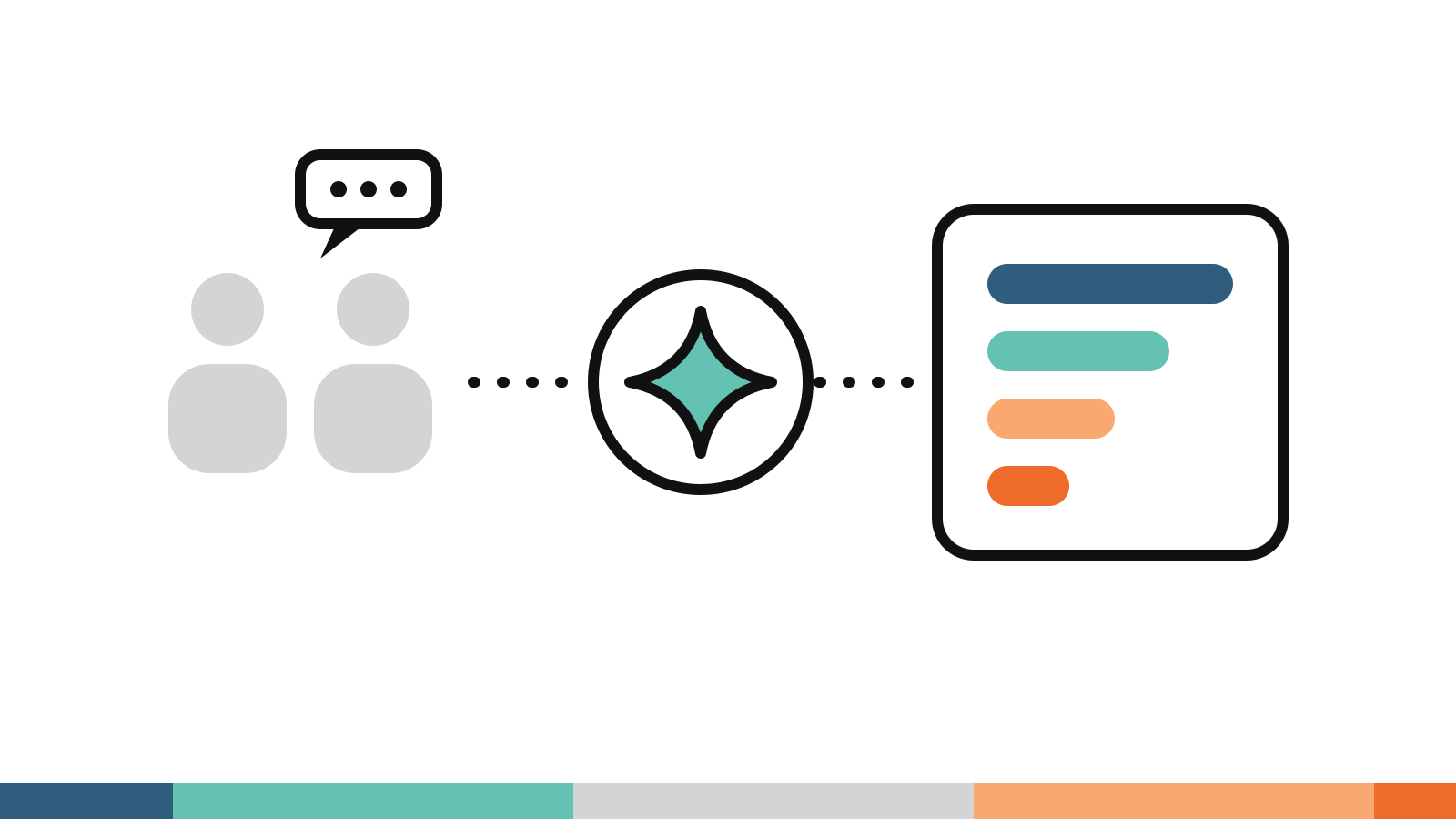
AI customer research uses AI to interview, survey, and analyze real customers at scale. Here is what it does well, what the evidence says, and what it can't do.
Customer research used to make you choose. A survey reaches 1,000 customers and tells you how many picked each answer. An interview tells you why one of them did. A team with a normal budget picked one.
AI removes most of that choice. An AI interviewer can talk with hundreds of customers at once and ask each of them a follow-up, and a model can do the first read of every transcript. The label has also stretched to cover products that do something else, such as a language model that plays your customer. This guide covers the first kind: AI does the work of the research, and real people answer.
We build Voicepanel, a customer research platform, so weigh what I say about ours accordingly. The claims about other vendors come from their own sites, the same sources behind our comparison of 20 research platforms. If we got something wrong, email hello@voicepanel.com and we'll fix it.
What is AI customer research?
AI customer research is customer research in which AI does part of the work a researcher or an agency used to do by hand: drafting the study, interviewing participants, translating answers, and analyzing the results. The customers are real. They answer in their own words, by voice, video, or text.
Two products that share the label work differently. Synthetic users and digital twins are language models that answer in place of customers, and I've written about where they hold up and where they fall apart. A general AI research assistant summarizes what has already been published about a market. Neither one asks your customer a question.
If your team calls this work voice of the customer, I've covered the methods, a program to run, and examples separately.
Where AI fits in a customer research study
| Stage | What AI does | What your team still does |
|---|---|---|
| Design | Drafts the questions and the discussion guide from your objective | Chooses the question and approves the guide |
| Recruitment | Screens people against your criteria and flags fraud | Decides who counts as the right respondent |
| Interviews | Asks each person your questions and follows up on their answers | Reads the first sessions and adjusts the guide |
| Translation | Translates the questions and the answers | Checks nuance in the markets you know |
| Analysis | Groups answers into themes, counts them, and attaches the quotes | Checks each theme against the evidence and decides what matters |
On Voicepanel those stages run in one study. The AI interviewer works in voice, video, and chat, and the same study can hold survey questions and usability tasks on a website, a prototype, or a mobile app. Participants come from 10+ panel partners with access to more than 30 million people, and studies run in 37 languages. On Enterprise you can also bring your own customers, read and edit the rules the AI follows at 13 stages, and have your own AI agents run studies through a REST API and an MCP server.
AI-moderated interviews
The AI-moderated interview is the new method in that table. A participant opens a link, and an AI interviewer asks your questions out loud or in text. When an answer is vague, it asks for an example. When an answer is surprising, it asks why. Every participant gets the follow-up, whether there are ten of them or a thousand.
The most careful public test I know of comes from Friedrich Geiecke and Xavier Jaravel at the London School of Economics. They built an open source AI interviewer and asked a team of sociology PhD students from Harvard and LSE to grade its transcripts. The AI-led interviews "were rated approximately comparable to an average human expert (under the same conditions)." Respondents wrote 142% more words than they did in open text fields, and they preferred the interview to typing into a box. The paper was published online in the Review of Economic Studies in October 2026.
One research team's experience matches. Ancestry's Consumer Insights and UX Research team was cautious about the AI. "We were skeptical at first," said Kendra Shapiro, who leads it. "We had a toolkit that was working well for us and weren't quite sure where Voicepanel could fit." After a few studies she said, "The speed was impressive, but more importantly, the insights we were getting were on par with what we took away from more time-intensive research studies." The team has now run more than 100 projects, and its case study reports research 10X faster than traditional survey vendors at a third of the budget.
An AI interviewer has limits, and ours does too. Ours doesn't watch a participant's screen and react to it during a task, which the moderators at Listen Labs and Outset do. And for a sensitive subject, or a visit to a customer's home, I'd still send a person.
AI surveys, AI focus groups, and AI interviewers
The search terms around this field overlap. Here is how I'd sort them.
- AI survey. A survey in which AI writes the questions or asks a follow-up after an answer. Qualtrics adds text follow-ups to a survey this way. In a Voicepanel study, a rating question can be followed by an AI follow-up that the participant answers by voice.
- AI focus group. The name covers two different products. Some simulate a group out of AI personas, with no customers involved. Others use AI to moderate conversations with real people. Ask which one you're buying. Ours interviews real people one at a time, so no one steers the room.
- AI interviewer. In research, the AI that runs a moderated interview. The same phrase is used for software that screens job candidates, which is a different product.
- AI market research and AI user research. The same methods, used by two teams. Insights and market research teams run concept tests, message tests, and brand questions with consumers. Product and UX teams run usability tasks on prototypes, websites, and apps. One study on Voicepanel can hold both, and our market research and user testing pages show each.
How research teams use AI customer research
Two customers that have published their work with us use it differently, and so do we.
- A mature insights team. Ancestry's researchers use it for foundational discovery, concept validation, message testing, and UX evaluations, with their own subscribers or a general consumer audience. Christina Sweetnam, Senior Manager of Consumer Insights, said the team can "get kind of a pulse on a question or topic within an hour."
- A startup with no users yet. Hint ran AI-moderated video interviews with homeowners recruited from our consumer panels before it had an app, and launched less than five months after its first study. "After a while, we noticed users were starting to say similar things with consistent themes," said co-founder Kyle Rush. "At that point we became confident in the core pillars." Read the case study.
- Our own research. For our report on how consumers use AI, we collected video responses from 4,814 consumers in 13 markets, translated the transcripts, and ran the thematic analysis on Voicepanel.
Where AI customer research falls short
Know four limits before you buy.
- It doesn't pick the question. A study built on a vague objective returns a tidy report about nothing in particular. The objective is still your team's work.
- Summaries smooth things over. A model's first pass favors the common answer. Read the quotes under each theme, and look at the answers that fit no theme.
- Fraud scales too. A paid study attracts people who aren't who they say they are, and a typed answer can be machine-written. Ask a vendor how it checks. We run automated fraud detection on every study, and Pay per project comes with a zero fraud guarantee.
- Some research needs a person. That includes sensitive subjects, home visits, and any session where the moderator has to react to what's on the screen as it happens.
What AI customer research costs
We checked what 12 research platforms publish and what buyers report paying. A single AI-moderated study with recruited participants runs about $5,000 to $10,000, and an annual platform license runs about $20,000 to $80,000. In almost every quote, most of the money goes to people: recruiting fees and participant incentives.
Our prices are public. A 100-person, 15-minute consumer study in the US costs $5,100 on Pay per project: $1,500 for recruitment, $1,500 for incentives, and a $2,100 platform fee, with study design, fieldwork, and first-pass analysis included. Enterprise is an annual license from $30,000, with no seat licenses and no per-response fee. The pricing page has a calculator for other sizes.
How to choose an AI customer research platform
Every research vendor now says it uses AI. Seven questions separate them.
- Who runs the research, your team or the vendor's staff?
- Are the respondents real people, and where do they come from?
- Can you read and change what the AI does, or only add instructions?
- Can your own tools and AI agents reach it through an API or an MCP server?
- Which methods fit in one study: interviews, surveys, usability tasks?
- Does it pass your security review, and does the vendor train on your data?
- Is the price public, and what does recruiting cost per participant?
Our comparison answers these for 20 platforms, with a source for every claim. If you're replacing a specific tool, I've also compared Listen Labs alternatives and UserTesting alternatives.
AI customer research FAQ
What is AI customer research?
Customer research in which AI drafts the study, interviews participants, translates, and analyzes, while real customers answer. Synthetic users are a different product, in which a model answers in place of customers.
Is AI customer research reliable?
The published evidence on interviews is positive. In a London School of Economics study, sociology PhD students rated AI-led interviews approximately comparable to an average human expert. Analysis needs a human check, because a summary can drop a minority view.
Does AI replace researchers?
No. It takes over scheduling, moderating, transcribing, and first-pass coding. A researcher still chooses the question, checks the findings, and decides what they mean for the business. Teams without a research department, such as Hint's founders, use it to run their own studies.
What is the difference between AI customer research and synthetic users?
In AI customer research, real people answer, and AI does the asking and the analysis. Synthetic users are language models that answer in place of people. The first is primary research. The second is a way to reuse research you've already done.
How much does AI customer research cost?
About $5,000 to $10,000 for a single study with recruited participants, or $20,000 to $80,000 a year for a platform license. On Voicepanel a 100-person consumer study costs $5,100, and Enterprise starts at $30,000 a year.
What is an AI-moderated interview?
An interview in which an AI interviewer asks the questions and the follow-ups, by voice, video, or chat, with a real participant on the other end. Many sessions run at the same time.
If you want to see how a study is put together, the study reference lists every block you can combine. Talk to us to run one.